





Article
10 Essential Accounting Tips for Black-Owned Businesses in 2026
In 2026, Black entrepreneurs continue to break barriers and build successful businesses across industries such as ecommerce, transportation, consulting, technology, logistics, beauty, real estate, and digital services. More Black-owned businesses are launching every year, creating jobs, strengthening communities, and helping build generational wealth. However, many entrepreneurs still face major financial challenges that can limit long-term growth. Rising inflation, changing tax laws, economic uncertainty, and increasing operational costs make financial management more important than ever before. While passion, creativity, and hard work are essential for success, poor accounting practices can quickly destroy even the most promising business. Many Black business owners struggle with cash flow management, bookkeeping, budgeting, taxes, and financial planning because they were never taught proper business accounting skills. Unfortunately, disorganized finances often lead to missed opportunities, unpaid taxes, unnecessary debt, and stressful financial situations. Accounting is not simply about tracking numbers—it is about understanding how money moves through your business and using that information to make smarter decisions. Whether you run a small online shop, a delivery company, a consulting agency, a restaurant, or a growing startup, mastering your finances will help you scale faster and protect your profits. Here are 10 essential accounting tips every Black entrepreneur should follow in 2026 to build a financially strong and sustainable business.

Separate Personal and Business Finances Immediately
One of the biggest mistakes many entrepreneurs make is mixing personal and business finances together. Using the same bank account for groceries, rent, entertainment, and business expenses creates confusion and makes it difficult to understand how your company is truly performing. Every Black entrepreneur should open a dedicated business bank account and obtain a separate business credit card as early as possible. This simple step improves bookkeeping, simplifies taxes, and helps establish professionalism. When your business finances are separated properly, it becomes easier to track income, categorize expenses, and identify profitable areas of your company. This also helps protect personal assets if your business is structured as a corporation or LLC. Lenders, investors, and grant organizations often look for organized financial records before approving funding, and clean accounts demonstrate responsibility and business maturity. Black-owned businesses seeking growth capital must show strong financial discipline to compete effectively in today’s economy. Separating finances also makes tax preparation easier because accountants can clearly identify legitimate business deductions. Even freelancers, side hustlers, and sole proprietors benefit from financial separation because it creates better visibility into spending habits and profitability. Building a professional financial structure from the beginning sets the foundation for long-term success and future expansion.
Invest in Reliable Accounting and Bookkeeping Software
Technology has transformed accounting for small businesses, and in 2026, there is no reason for entrepreneurs to rely entirely on spreadsheets and manual bookkeeping. Modern accounting software allows Black entrepreneurs to automate many time-consuming financial tasks while improving accuracy and efficiency. Platforms such as QuickBooks, Xero, Wave, FreshBooks, and Zoho Books can automatically track expenses, reconcile bank transactions, generate invoices, monitor cash flow, and produce financial reports in real time. These tools save valuable time and reduce costly errors caused by manual data entry. Many platforms now include artificial intelligence features that categorize transactions automatically and generate financial insights that help entrepreneurs make smarter decisions. Cloud-based accounting systems also allow business owners to access financial information from anywhere using smartphones or laptops. This flexibility is especially useful for entrepreneurs managing multiple projects, ecommerce stores, transportation services, or remote teams. Bookkeeping software also integrates with ecommerce platforms, payroll systems, payment processors, and inventory management tools, helping business operations run more smoothly. Instead of wasting hours organizing receipts manually, entrepreneurs can focus more energy on customer service, marketing, networking, and growth opportunities. Financial technology gives Black-owned businesses the tools needed to compete effectively in today’s digital economy.

Create a Realistic Budget and Financial Plan
Every successful business needs a clear financial roadmap, and that roadmap begins with budgeting. A business budget helps entrepreneurs control spending, prepare for emergencies, and allocate resources strategically. Without a proper budget, many businesses overspend on unnecessary expenses such as subscriptions, inventory, advertising campaigns, or office equipment that does not generate meaningful returns. Black entrepreneurs should create monthly, quarterly, and yearly budgets that estimate revenue, operational costs, payroll, taxes, marketing expenses, transportation costs, rent, software subscriptions, and savings goals. Budgeting becomes even more important during periods of economic uncertainty when inflation and market instability can affect profits. A strong budget helps entrepreneurs understand exactly how much money is needed to operate efficiently while still maintaining profitability. Budgets also help business owners prepare for expansion, hiring employees, purchasing equipment, or launching new products and services. Reviewing financial performance regularly allows entrepreneurs to identify areas where costs can be reduced and profits improved. Many successful Black business owners use budgeting as a strategic tool to maintain discipline and avoid emotional spending decisions. Businesses that follow structured financial plans are more likely to survive economic downturns and achieve long-term growth.
Keep Organized Financial Records and Track Everything
Maintaining organized financial records is one of the most important accounting habits any entrepreneur can develop. Every receipt, invoice, contract, payment, expense report, bank statement, and tax document should be stored properly and updated consistently. Organized bookkeeping protects your business during tax audits, helps identify spending patterns, and provides accurate information for decision-making. Black entrepreneurs often juggle multiple responsibilities at once, making organization even more important. Waiting until tax season to sort through months of receipts and expenses creates unnecessary stress and increases the likelihood of mistakes. In 2026, digital tools make recordkeeping easier than ever. Mobile apps can scan receipts instantly, while cloud storage systems safely store financial documents online for easy access. Entrepreneurs should schedule weekly or daily bookkeeping sessions to record transactions and review expenses. Consistency prevents financial chaos from building over time. Detailed records also help identify profitable services, products, or marketing strategies so businesses can focus on activities that generate the highest returns. Organized financial records demonstrate professionalism when applying for loans, grants, partnerships, or investor funding. Strong bookkeeping practices not only improve tax accuracy but also provide the financial clarity needed to make confident business decisions.
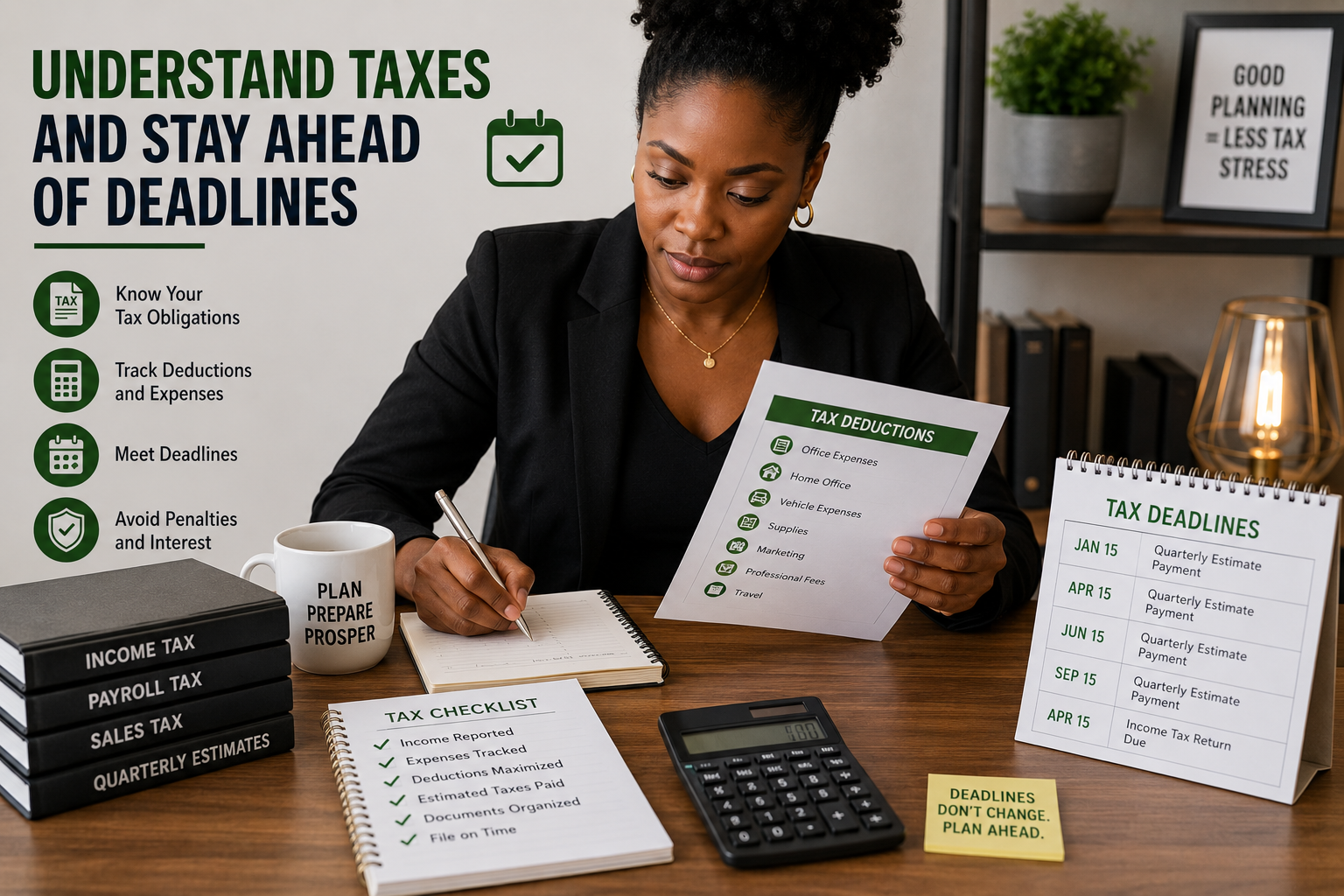
Understand Taxes and Stay Ahead of Deadlines
Taxes remain one of the most stressful aspects of entrepreneurship for many small business owners. Unfortunately, ignoring taxes or waiting until the last minute can lead to penalties, interest charges, and serious financial problems. Black entrepreneurs should take time to understand the taxes that apply to their businesses, including income taxes, payroll taxes, sales taxes, self-employment taxes, and quarterly estimated tax payments. Ecommerce businesses especially need to understand sales tax laws in different states and provinces because tax obligations may change depending on where customers are located. One of the smartest financial habits entrepreneurs can develop is setting aside a percentage of every payment received into a dedicated tax savings account. This prevents situations where business owners spend money that should have been reserved for taxes. Entrepreneurs should also track tax deductions carefully, including mileage, internet expenses, office supplies, software subscriptions, advertising costs, business meals, equipment purchases, and home office expenses. Hiring a qualified accountant or tax professional can help maximize deductions while ensuring compliance with changing tax regulations. Businesses that stay ahead of deadlines and plan for taxes throughout the year experience far less financial stress and avoid costly surprises during tax season.
Master Cash Flow Management for Long-Term Stability
Cash flow is the lifeblood of every successful business. Even profitable companies can fail if they run out of cash at the wrong time. Many Black-owned businesses struggle not because they lack customers, but because they lack consistent cash flow management systems. Entrepreneurs must monitor how money moves into and out of the business every week. This includes tracking invoices, customer payments, payroll, supplier costs, rent, transportation expenses, inventory purchases, subscriptions, and marketing costs. Late-paying clients can create serious financial problems, especially for service-based businesses that rely on consistent revenue to operate. Business owners should invoice clients promptly and follow up on unpaid invoices regularly. Offering digital payment options and automated reminders can encourage faster payments. Entrepreneurs should also build emergency savings funds to handle unexpected expenses such as equipment repairs, vehicle maintenance, economic slowdowns, or seasonal declines in sales. Monitoring cash flow carefully helps business owners anticipate financial problems before they become emergencies. Positive cash flow provides flexibility to invest in marketing, hire employees, expand operations, or purchase new equipment confidently. Strong cash flow management creates financial stability and allows Black entrepreneurs to focus on growth instead of constantly worrying about unpaid bills and shortages.

Automate Invoicing and Choose the Right Accounting Method
Another important accounting strategy for Black-owned businesses in 2026 is automation. Entrepreneurs waste countless hours manually sending invoices, following up on payments, and organizing financial data. Automated invoicing systems simplify these processes by generating invoices automatically, sending payment reminders, tracking overdue balances, and allowing customers to pay online quickly. Automation improves professionalism, reduces human error, and strengthens cash flow because businesses get paid faster. In addition to automation, entrepreneurs should choose the right accounting method for their business. The two main accounting methods are cash-basis accounting and accrual accounting. Cash-basis accounting records income when payments are received and expenses when they are paid, making it simpler for smaller businesses and freelancers. Accrual accounting records income and expenses when they are earned or incurred regardless of payment timing, providing a more accurate picture of long-term profitability. While many startups begin with cash accounting because it is easier to manage, growing businesses may eventually need accrual accounting to satisfy lenders, investors, or tax requirements. Choosing the right accounting method and automating repetitive financial tasks allows entrepreneurs to operate more efficiently and focus on scaling their businesses strategically.
Build Generational Wealth Through Financial Discipline
Black entrepreneurs are creating powerful businesses that are transforming communities, generating employment opportunities, and building generational wealth for future generations. However, sustainable success requires more than talent, passion, and determination. Financial discipline, organized accounting systems, and strategic planning are essential for long-term business growth. Entrepreneurs who separate their finances, use accounting software, maintain organized records, manage cash flow effectively, budget carefully, automate processes, and stay ahead of taxes position themselves for greater profitability and stability. Accounting should not be viewed as a burden or a boring administrative task. Instead, it should be seen as a powerful tool that provides clarity, confidence, and control over your business future. The more Black entrepreneurs understand their numbers, the better equipped they become to negotiate contracts, secure funding, reduce unnecessary expenses, and make smart investment decisions. In 2026, businesses that master financial management will have a stronger advantage in an increasingly competitive marketplace. By implementing these essential accounting tips consistently, Black-owned businesses can grow stronger, become more resilient during economic challenges, and continue building lasting legacies that positively impact families and communities for years to come.
share this
Related Articles
Related Articles



STAY UP TO DATE
kEEP UP WITH WHAT'S GOOD AT MYBROTHASPOT
Receive frequent updates from Mybrothaspot, and get a heads up on upcoming events.
Contact Us